
I got into a discussion on ventilation and indoor air quality (IAQ) last week.
Which, by the way, are essential aspects of Building Performance, yet not commonly analysed. Or at least not in much detail.
The discussion, in brief, was around these two questions:
- How much could we reduce the fresh air ventilation rates if we are able to treat and remove pollutants from recirculated air?
- What are the potential energy savings from doing this?
The answers to these questions from the person I was discussing with were (not surprisingly):
— A lot, and a lot.
Mine was:
— Maybe not that much, really. But it’d need to be analysed using detailed dynamic simulations.
I’ll give you the full context:
A Spanish engineering company, specialised in IAQ treatment using electrostatics for enhancing filtration of pollutants, has gone to court over projects for public buildings being approved without including a comparison of high-energy-efficient alternatives (theirs in particular).
Their point is that Spanish building regulations (based on EU directives) require projects to include high-efficiency alternatives for thermal systems, or at least a feasibility assessment to justify why they’re not included in the HVAC design. Their air treatment system isn’t actually a thermal system, but they argue that it’s equivalent since it reduces thermal loads.
A bold initiative in any case.
And it’d be great if it helps making appropriate assessments of the efficiency of HVAC alternatives compulsory.
However, when they shared their calculations of one of their case studies, I found them too simplistic and rather biased towards showing high energy savings.
So, I’m not sure how far this will go in court. We’ll see.
In my view, the actual savings of this or similar measures can only be determined properly by using detailed dynamic simulations.
Not just extrapolating from basic design parameters, as it was the case.
Now, let’s analyse the technical, building performance aspects of this discussion further:
Why is fresh air ventilation needed? How much is enough? How is it related to energy efficiency?
And how can all this be calculated/simulated more accurately?
I won’t get into the full story of the evolution of ventilation and air quality in buildings here, but it’s an interesting one, which still keeps evolving.
From body odour and cigarette smoke removal, through respiratory infections prevention, to current concerns about the impacts on health of Particulate Matter (especially PM2.5) and Volatile Organic Compounds (VOCs).
As well as managing humidity from breathing or other vapour releasing activities, and limiting CO2 levels.
Adequate ventilation is an essential aspect for determining whether a building performs its duty of promoting its occupants’ health rather than their sickness.
The typical approach to ventilation
The current approach in most regulations and standards is normally to provide a minimum ventilation rate based on the expected occupancy level of the spaces and the type of activity in them.
Those rates are considered to be sufficient for diluting airborne pollutants, viruses, bacteria, and particles to safe levels. As well as for keeping humidity and CO2 concentration within an adequate range.
For typical, sedentary activities, it’s assumed that a ventilation rate of around 10 – 12 l/s/person achieves this objective.
These ventilation rates are often correlated with CO2 concentration. Not because CO2 is considered harmful at those levels, but because it’s relatively easy to measure with sensors.
CO2 concentration has become a proxy for the level of ventilation and air quality in a space.
The CO2 concentration as a function of ventilation (and vice versa) can be obtained in steady state using this formula:

Outdoor CO2 is currently at about 430 ppm (and rising).
The generation rate for sedentary activity is approx. 0.005 l/s/person.
If we apply this formula to a ventilation rate of 10-12 l/s/person, we get a CO2 range of around 900 ppm.
And a rise in CO2 concentration to 1500 – 2000 ppm would mean that the ventilation rate per person is only around 4 l/s, which would be insufficient for diluting pollutants.
This is the approach used by demand control ventilation systems (DCV) that use CO2 sensors to modulate the fan speed to match the actual occupancy level and save energy.
New approaches
That approach is being reviewed and challenged by air quality experts and associations as important as ASHRAE.
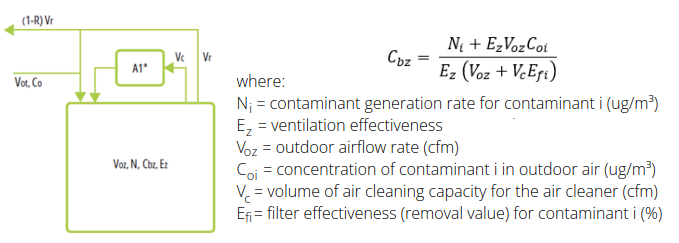
In ASHRAE’s ventilation and air quality standard (62.1), they include an alternative method to calculate the required flow rates, the Indoor Air Quality Procedure (IAQP).
The IAQP is a more direct approach, which calculates the concentration of each specific contaminant and can also include the effect of applying contaminant removal systems.
This method allows to compare the values obtained for each pollutant directly with reference limiting values.
Furthermore, using this approach with air cleaning or enhanced filtration systems can allow ventilation flow rates to be reduced, enabling the installation of simpler HVAC systems and delivering energy and carbon savings.
Example calculation schematic:
Calculating energy savings
The theory is clear, if we can reduce the ventilation flow rate while achieving the same IAQ levels by other means, fans will use less energy.
Additionally, a smaller volume of outside air will require less energy for conditioning it to internal comfort temperatures.
However, to determine the actual savings in each specific building, calculations shouldn’t be done using simplistic approaches.
Such us using just the winter and summer design conditions of internal and external temperatures, or their monthly averages.
It’s very likely that energy saving results will be far from accurate this way. Since they won’t capture the specific thermal dynamics of each building.
For example, there might be seasons during the year when introducing a higher volume of external air is beneficial for mitigating internal and solar gains. Saving cooling energy.
We shouldn’t forget either about keeping relative humidity in the adequate range (40%-60%).
As well as CO2 within reasonable limits, since there is growing evidence that concentrations above 1000 or 1500 ppm can have adverse effects.
All this can’t be determined without a dynamic simulation model that includes all the HVAC and thermal envelope features. As well as realistic scenarios of internal gains and use of spaces.
Can we include the pollutants in dynamic energy models?
CO2 and relative humidity are always simulated. However, energy models don’t include pollutants.
There are specialised tools that can do very detailed simulations of indoor pollutant dynamics, which can be connected to energy model outputs.
But this newsletter is getting a bit lengthy, so we’ll leave that for another edition!
We still don’t have any subscribers. Actually, it’d be surprising if we had, since subscriptions aren’t active yet!
So, in this edition we don’t have any further practical content.
If there are any aspects of ventilation and air quality that you’d like to learn more in future editions, feel free to let me know.
These are other aspects I already plan to discuss in the future:
- Different approach to ventilation in residential and non-residential buildings
- Hybrid natural-mechanical ventilation strategies
- Detailed pollutant modelling
Have a great week!