
In recent years, we are seeing a significant increase in the use of detailed energy and thermal models for buildings, aiming for more accurate representations of the proposed designs and better forecasts of their future performance in real life. From detailed AC and ventilation system models, which simulate designs to the sensor level in minute timesteps, to three-dimensional multiphysics simulation tools to test building envelope elements.
That’s great news, of course. They valuable additions that strengthen the Building Performance assessment discipline. And they definitely increase our chances of getting building designs right and avoiding future, real-life underperformance issues. I won’t be the one to complain about having to use them, especially since this has been one of the main areas of focus in my career.
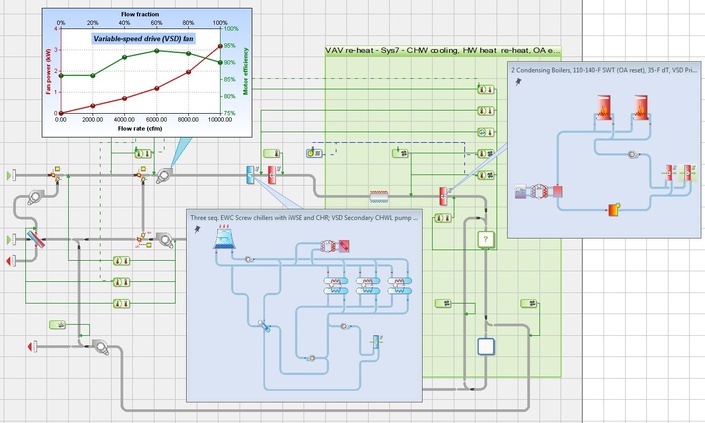
ApacheHVAC image from IES Virtual Environment
However…
We should also make sure we apply our technical judgement, broader experience in the construction sector, and plain common sense to ensure we use them to solve or avoid real problems. Rather than for the sake of using the latest technology or because we are expected to do so. In other words, we need to make sure the scenarios we are modelling won’t be real only in our computers, and that they are used as a tool for better decision making that will have benefits in the real world.
I won’t repeat again the famous aphorism in this discipline: “All models are wrong, but some are useful” (Sorry, I did it!). But it’s important to keep this in mind. That the real purpose of detailed models and simulations should be to be useful, even more than to be accurate. Because models will never capture all the complexities of reality anyway, regardless of how detailed they are.
So, with that in mind, what are in my view the “dos and don’ts” we should consider to make the most of the powerful modelling tools we now have in our hands?
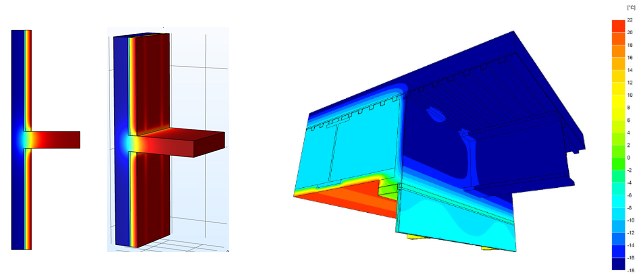
3D thermal bridge calculation images from COMSOL and TRISCO
The DOs
Clarify the objective or the problem to solve/avoid before choosing the modelling approach
This might sound obvious, but more often than not detailed modelling is requested and carried out without a very clear idea of its purpose, and how it will help improve the design or find the best solutions for that specific project. Sometimes, once the objectives are clarified, it turns out that a simpler approach can be more practical for deciding between options.
Focus on getting good input data (Garbage In, Garbage Out)
We all know (or should) that the quality of outputs from any system depends directly on the quality of inputs to it. It has become even clearer now, with AI, that even the smartest technology ever created cannot overcome the limitations of poor inputs. So, if we really want to be more demanding about the accuracy and usefulness of outputs, we need to be even more demanding about the accuracy and usefulness of inputs.
Where some inputs are uncertain, assess different scenarios and get a range of potential outcomes
It is more convenient (and often expected) to come up with a single scenario to model and a single set of results to report. However, if there is uncertainty in some of the inputs, the outputs shouldn’t appear certain either. We should rather get a range of potential outcomes based on a set of plausible scenarios, caveating the limitations of the analysis, and base decisions on the full picture.
Get a second opinion on the approach and results
Detailed performance models are complex. Even the most experienced “pros” can sometimes overlook something important in the inputs, or miss some errors in the model and results. QA procedures (or just having someone else with experience look at it) are essential.
The DON’Ts
Don’t assume everyone requesting or involved in these analyses fully understands what they entail
These analyses have become sort of trendy. Terms like TM54, NABERS, or WUFI, and assessments using detailed HVAC modelling or hygrothermal physics tools, are sometimes understood as if they were the new compliance methods (or the new box to tick to avoid problems). However, when done properly, detailed performance assessments are far from being a tick box exercise. They require a lot more involvement from the whole project team to determine specific objectives and appropriate inputs. But not many people requesting them really understand this and its implications.
There is a common misunderstanding (or a more convenient view for some) that the notorious performance gap observed between the regulations compliance models and real life energy consumption is due to the modelling methodologies alone. But the reality is that the performance gap has a lot more to do with the lack of involvement and commitment from project team members than with anything else.
Don’t assume everyone carrying out these analyses fully understands what they entail
Supply follows demand. Therefore, there isn’t a lack of companies and modellers willing to follow the trend and carry out these assessments just as the new tick-box requirement. But not everyone using the software and offering these services fully understands what it takes to perform accurate and useful assessments. If they don’t even consider what we’ve discussed in the previous “DOs” section, chances are they don’t have the required experience or fully comprehend their purpose.
Don’t expect inexperienced people to get good results just because the tools look smart
First of all, tools are never as smart as they’re sold to be. But it also takes experience to understand the matter well, to know what good inputs look like and how to obtain them, and to interpret the outputs correctly.
In fact, a simpler tool used by an expert professional can be a lot more useful than a very smart one used by an apprentice. I guess this is clearer to see if we were talking about manual labour, but the same goes for technical work.
Don’t commoditise it (Don’t go cheap!)
Detailed performance modelling, especially when done properly as described above, takes time and significant experience. It’s far from being a commodity that you can get from anyone just looking at the lowest price. If these services are offered too cheap, it will be materially impossible that they are provided with the required quality, and that they are as useful as they should be to meet your project objectives.
Key Takeaways and Conclusion (courtesy of our dear AI)
For our AI fans and busiest readers, I’ve asked Gemini to provide a “Key Takeaways” section and conclusion. It came up with a decent summary:
- Define the “Why” First: Never start a model without a clear objective. Detailed simulations should solve specific problems, not just satisfy a requirement or follow a trend.
- Prioritize Inputs Over Tools: The “Garbage In, Garbage Out” rule is essential. Even the most sophisticated software cannot compensate for poor-quality data or unrealistic assumptions.
- Embrace Uncertainty: A single “perfect” result is often an illusion. Use scenario testing to provide a range of outcomes, helping stakeholders make informed decisions based on real-world variability.
- Expertise is Non-Negotiable: Tools don’t model buildings; people do. Ensure the person behind the software has the technical judgment and sector experience to interpret the data correctly.
- Utility Over Accuracy: Remember that a model’s primary goal is to be useful for decision-making. A simpler, well-understood model is often more valuable than a complex “black box” that no one understands.
- Quality Requires Investment: Avoid commoditising performance modelling. Cheap, “tick-box” assessments rarely provide the insight needed to bridge the performance gap and may lead to costly real-life failures.
Ultimately, detailed modelling is a formidable asset for the future of construction, but only if we remember that these tools are meant to augment our professional judgement, not replace it. So, by all means, let’s use the best technology available — but let’s ensure we are checking our models against reality every step of the way. In the end, the most powerful tool in any performance assessment isn’t the software; it’s the common sense we use to drive it.
For further clarity and support in Building Performance modelling, get in touch.